


BimmerTech
Mar-20-2025
BMW Fault Codes – What Do They Mean and How to Deal with Them?
With modern technology in vehicles come modern problems - and fault codes are their messengers! Long gone are the days of making sure the points in your distributor are good. Now everything is electronic and BMW is taking that to the next level. In a BMW, everything has a module and even particular modules have modules. These allow for the “ultimate driving experience,” but when you hear that dreaded BMW warning chime, they can become the ultimate pain in the butt instead - especially all BMW engine codes!
In this article we’ll cover:
- The basic BMW fault codes that you might find in your modern bimmer.
- List of BMW fault codes
- General guidelines for reading the BMW fault codes.
- What might cause some of them.
- How to reset BMW fault codes.
Important: while some of these fault codes may be the same in your BMW, please note that the model, trim, and production year could lead to slightly different outcomes and reasons. Take this article as a guide, but not an exact solution. You should always consult your local mechanic or dealer before attempting to fix a diagnosis you are not entirely sure on. With some BMWs, even unplugging something at the wrong time can fry a module.
With all of that out of the way, let’s get to it!
BMW Fault Codes and Their Meaning
First off, what are fault codes? Fault codes simply let you know that something is not behaving the way it should in your BMW. Check engine lights, battery lights, fuel lights, and so on are your first indication that something is wrong.
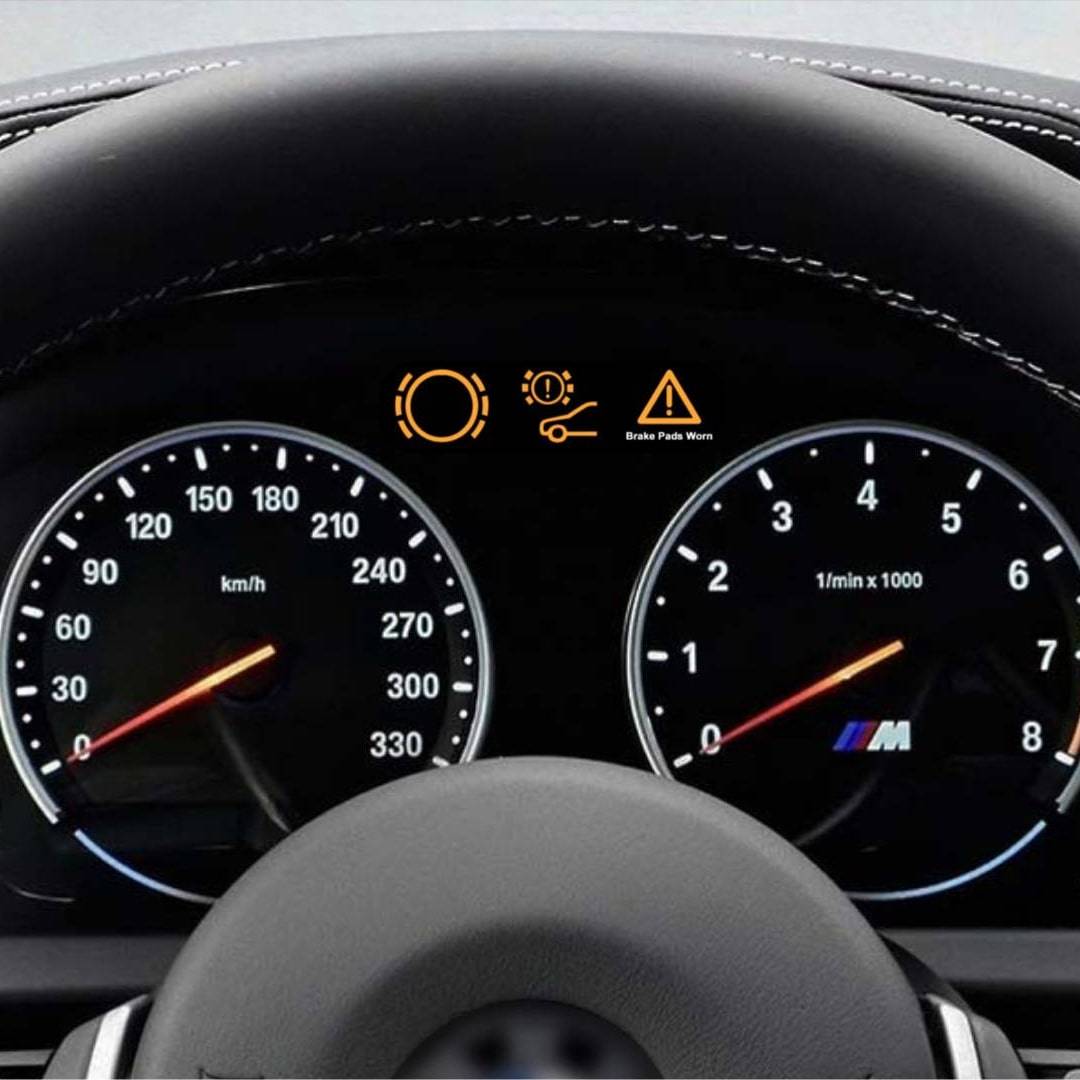 Sometimes your BMW might tell you what’s wrong or at least point you in the right direction on your iDrive display. Most of the time, you will just have to rely on a light that shows up on your gauge cluster. We already have an article on the different BMW dash lights that contains a pretty good overview of what symbols you can see in your car and what they mean.
It may be helpful to learn what the specific fault code you are getting is though. This can help you with knowing if or just how much you should be panicking! Sorry… We had to. We’ve all been there, right?
Anyway… one of the best ways to check for the exact code is with an OBD-II scanner/code reader. This device will plug into the OBD-II port in your BMW and read all of the errors. Depending on the BMW fault code reader you have, it will either tell you what the issue is or give you the alphanumeric code, which you can then look up.
You might also just be able to look up what’s wrong in either the small display in your gauge cluster or on your iDrive display. Nour Hummadi gives a good overview on how to check these BMW fault codes out in older cars.
Learn How to Read BMW Fault Codes
Great! You now know how to check for these codes. Now what the heck is a P1083!? Once you know your code, Google becomes your friend, but you’ll still need to remember that warning we said at the beginning.
The code P1083 is related to engine fault codes in a BMW and indicates a Fuel Control Mixture Lean (Bank 1 Sensor 1) issue. This means that the engine's air-fuel mixture is too lean on Bank 1, as detected by the pre-catalyst oxygen sensor. When this happens, it suggests that there is too much air or not enough fuel in the combustion process, leading to irregular readings and triggering the code. So… Now what?
Well, this code can mean anything from a vacuum leak to a failing mass airflow (MAF) sensor. Both of these issues have different causes, costs, and locations in your BMW, requiring different diagnostic approaches and skill sets to fix.

Some codes may be more specific, but other ones might cause you to do the “parts cannon” method: throwing random parts at your car until the problem goes away. You might get it on the first try or you might get it on the fifth. A reputable mechanic or dealer will do their best to nail the problem on the first try with the knowledge and diagnostic tools that they have.
If you want to truly learn how to read OBD codes, OBD-Codes has a great breakdown on what all the digits mean in these codes. Of course, we don’t expect you to learn what the last couple of digits in each code mean, but knowing the first and third can help a lot with quick troubleshooting. For example: 4 in the P0456 is “Emission Control.”
These codes are universal with ODB-II vehicles, so they won’t ever really say, “you need to replace this exact part in your 2015 328i,” but it will point you in the right direction.
INPA and ISTA
If we’re going to talk about BMW, we really should talk about these two things. INPA and ISTA are both pieces of BMW specific diagnostics software. A “P Code” is a standard yet generic code that applies to all vehicles, but BMWs are a bit more intelligent and can tell computers with the right software what’s really wrong.
The problem is that you can’t just run down to your local auto parts store to get this. BMW covets this software, so if you manage to find it, it’s most likely from a shady source. There is a version for the general public, but… It’s more barebones.
BMW Fault Codes List
Now that you're a pro at knowing what the warning lights on your BMW mean, how and where to find/see the codes, and where to look to see what they mean, it’s time to dive deeper. What are some of the common ones your BMW may throw?
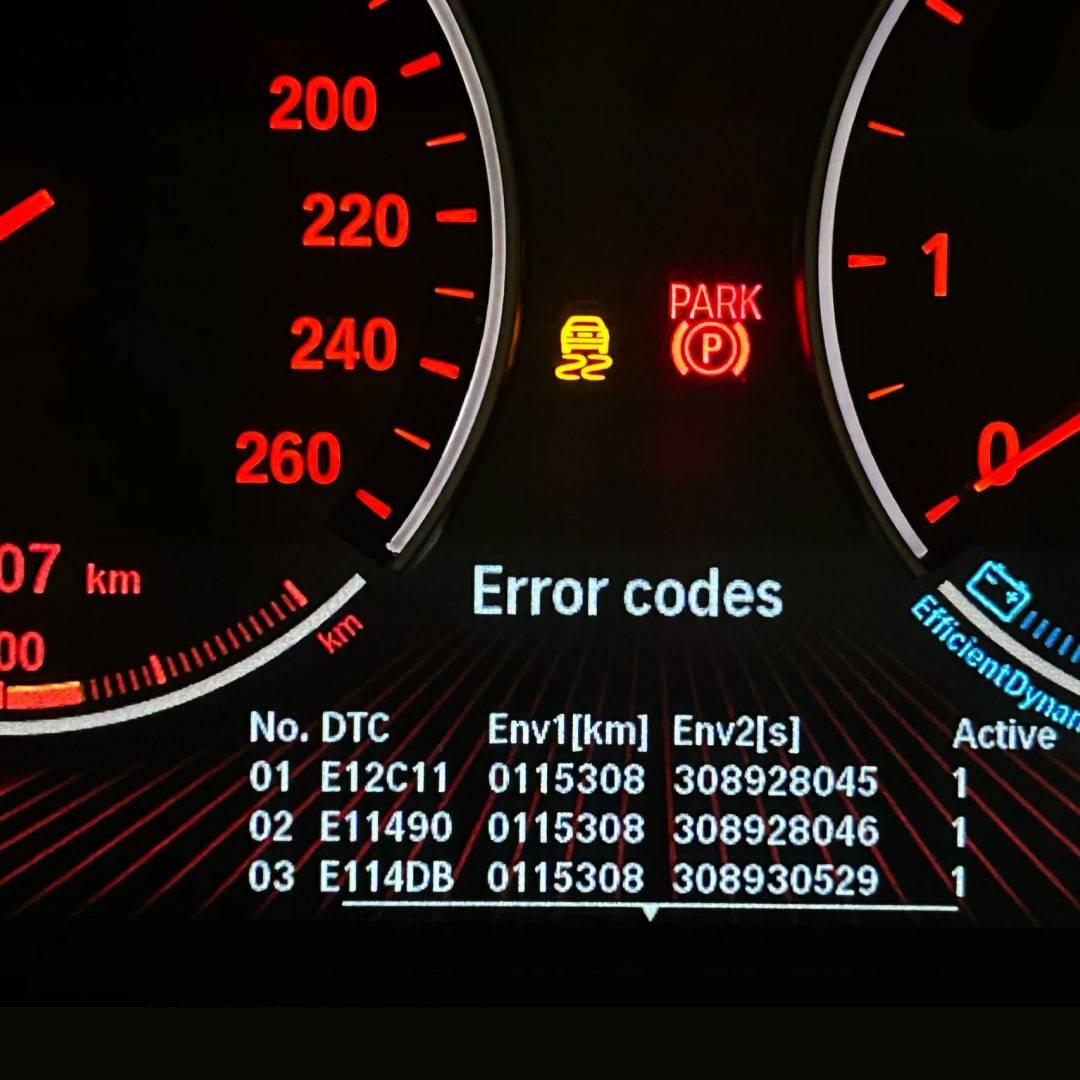 We’re going to be real… This will vary from BMW to BMW, but there are a few that will pop up a bit more often. I mean, come on… No car is perfect. It’s also worth noting that as BMWs get more and more advanced, there are more and more sensors, modules, and components that can go wrong and throw codes.
Let’s take a look at some top BMW fault codes list and their meanings.
| Code group | Code | What it means? |
| BMW Transmission Fault Codes | P0705 | A problem with the range sensor, which sends information to the car’s computer |
| P0743 | A problem with the torque converter clutch solenoid | |
| P0750, P0755, P0760, P0765, P0770, P2706, P075A | Shift solenoid A, B, C, D, E, F, or G malfunction (respectively) | |
| BMW Engine Fault Codes | P1083–P1086 | Fuel rich/lean codes |
| P1087–P1089, P1094–P1098, P1132–P1139, P1151–P1157, P1176–P1187 | All various O2 sensor codes | |
| P1340–P1365 | Misfires | |
| P1580, P1632–P1639 | Throttle valve problems | |
| Other BMW Fault Codes | P0442 | Small evaporation (EVAP) system leak |
| P0456 | Gross/large EVAP system leak | |
| P0446 | Very small EVAP system leak | |
| P0467 | Fuel cap loose/off |
How To Reset BMW Fault Codes
Keep in mind that when it comes to resetting or clearing codes, there are a couple ways to do it, but if you don’t fix the problem, it will come back. So make sure you fix the problem first before attempting to get rid of the codes!
 Using a scanner is probably one of the easier solutions. As long as your scanner has a clear function, all you have to do is follow the steps on your scanner. Generally this involves plugging in your scanner, turning on the auxiliary power to your BMW without starting your BMW, running the clear function on your scanner, and you should be good to go.
Alright, so what do you do if you don’t have a scanner? There is a way to clear BMW fault codes without a scanner, but keep in mind that this usually works only with codes related to service warnings. The best way for clearing codes will still be a scanner.
Turn on your auxiliary power without starting the car, and if available, hold the button on your gauge cluster. When your service reminders show up on your cluster, you can press to cycle through. Hold down on the one you want to reset, and then hold it down again to confirm and reset it.
One of the last methods to try is to simply disconnect your battery. Since it is most likely located in your trunk, make sure you tie a towel around your trunk latch. This will stop your trunk from locking if it accidentally gets closed, which will stop you getting locked out of your car. Some say leave it disconnected for 10 minutes, some say 30, and some say a few hours. 30 is a good place to start, and it should clear your codes.
Just remember that for all of these methods, the codes WILL come back if you don’t fix what caused them.
To Sum It All Up…
BMW fault codes are not fun. They can mean thousands in repairs, or maybe just a new fuel cap! Hopefully this guide will help you put your mind at ease so you don’t jump to the most expensive repair. Don’t forget to check out our YouTube channel for other helpful maintenance and DIY focused videos for BMW, MINI, Supra, and Tesla.
Popular posts:




and get to know all compatible products for your BMW or MINI
Where to find your VIN?
FAQ
Comments(0)
All ratings