


Radoslaw Zbroinski
Jul-22-2026
Alpha One Signature Edition Speakers – Talking to the Guys Behind the Leap
When did you decide that Alpha One Original wasn’t enough?
Who is the Signature Edition customer?
How is designing speakers for a BMW cabin different from designing speakers for a home listening room?
What is the role of ferrofluid cooling & damping?
What does the ventilated voice coil gap & Faraday’s ring do for S45/40 speakers?
What makes the S90 punch that far above a typical woofer?
Why would you upgrade Alpha One Originals to the Signature Edition?
What is the best demo track to listen to on Signature Edition Speakers?
Alpha One Signature Edition Speakers – Why It’s Worth It?
“The leap? What do you even mean by that?”
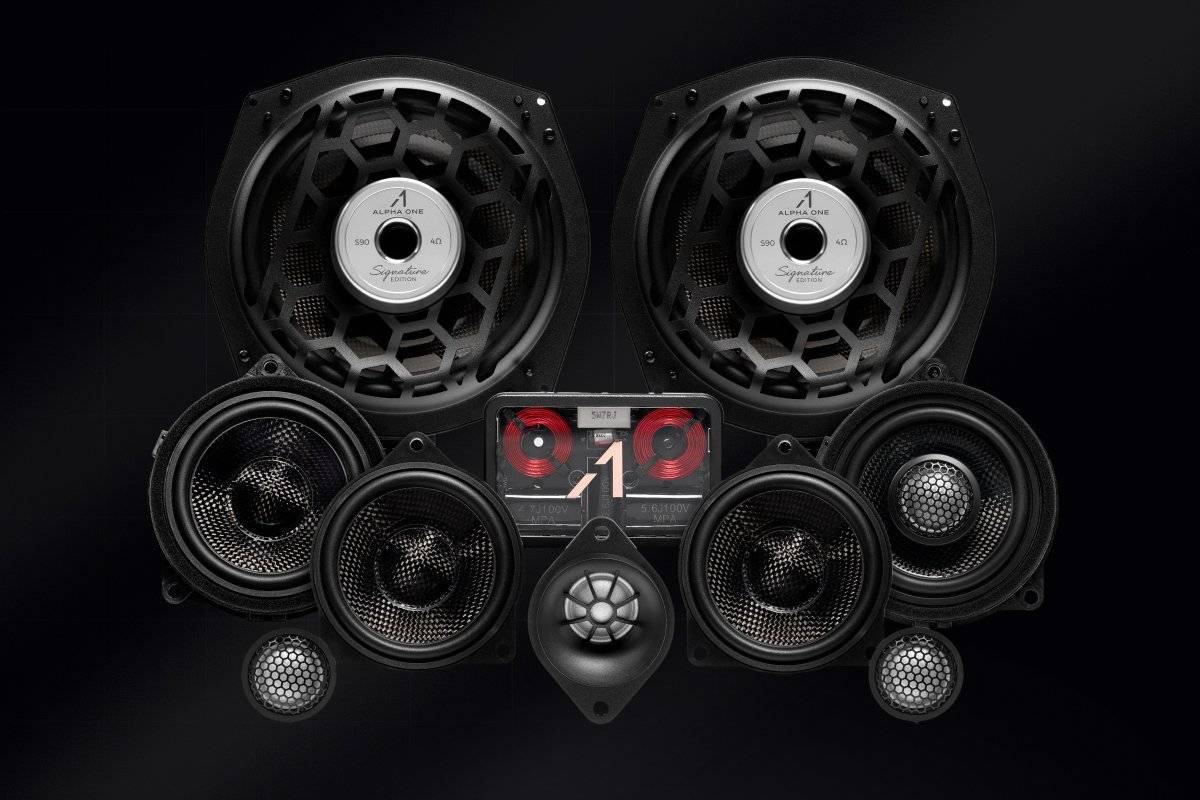
A giant technological leap for the BMW audio aftermarket, of course – our Alpha One Signature Edition Speakers. However, instead of touching on all the marketing bases we already covered on their website linked above, today I wanted to show you a more personal side to these excellent pieces of hardware.
Meet Mac and Jakub: the guy who’s been with Alpha One since the beginning and the guy who made Signature Edition Speakers possible, in that exact order. Obviously, that’s not to downplay the role of other Audio Team members; they all played a crucial part in bringing the Signatures to life. But it was Mac’s vision and Jakub’s expertise that gave direction to the whole development process.
In this article, I’m going to interview both of them for you and bring you some behind-the-scenes insights regarding our final statement (is it really final though…?). So, read on to learn what makes the Signature Edition different and why it’s everything.
When did you decide that Alpha One Original wasn’t enough?
- RADEK: By many, the Alpha One Original line is already considered one of the best plug-and-play BMW upgrades on the market. At what point did you look at that product and say, "this isn't enough, we need to build something even better"? Was there a specific moment, a customer conversation, or a piece of music that triggered it?
MAC: The decision was made 5 years ago. We knew we could do even better. Simply put, we desired more – a higher-class speaker system that would exceed the Alpha One Originals in various areas, such as power handling.
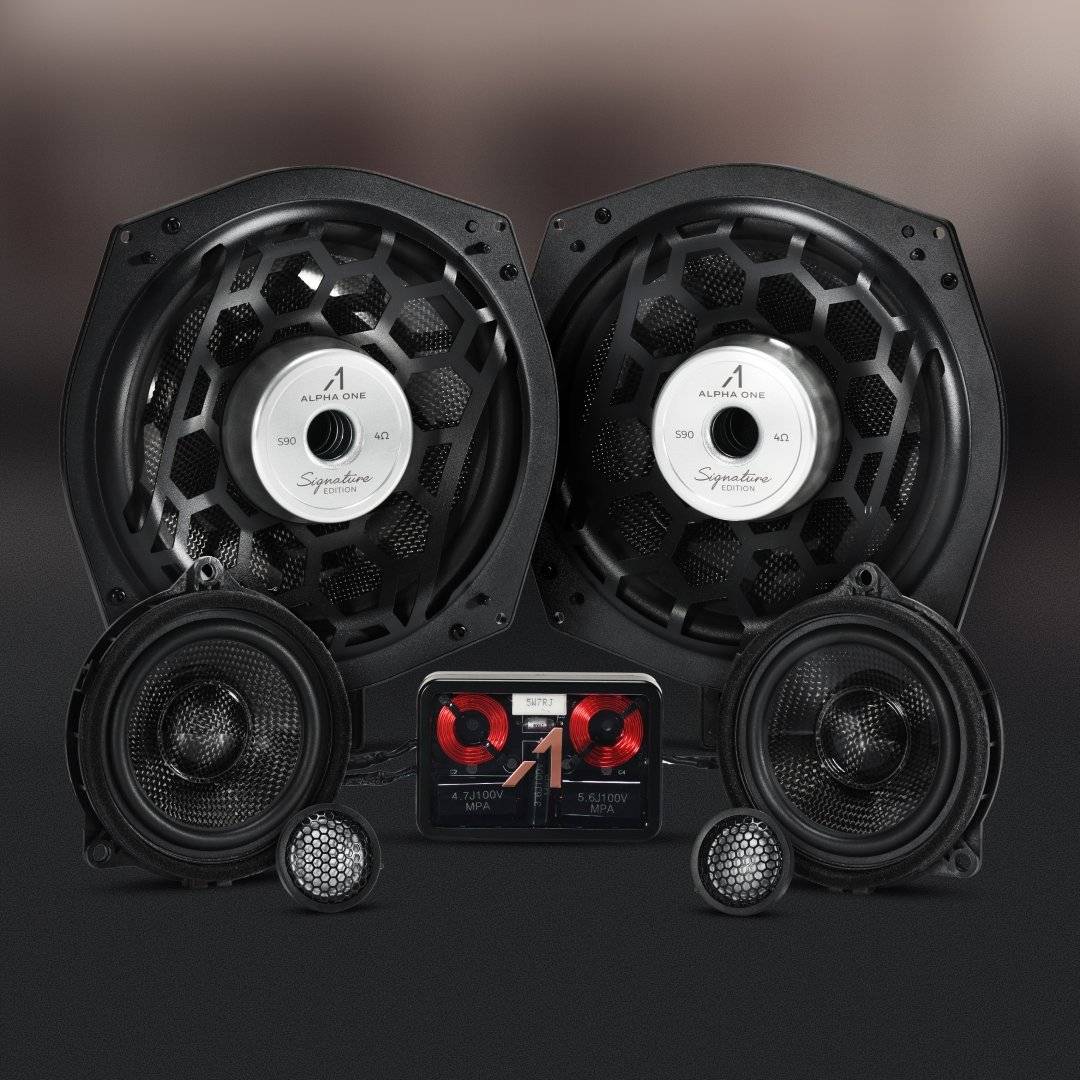 An important piece of context for this is that when we released the Originals, they were designed and optimized specifically for the weaker factory amplifiers. Back then, there were no UP8 or UP10 amps in our offer, not to mention the Lightwave. At the same time, we really wanted to bring the best possible sound quality to people who either didn’t want or couldn’t get an amplifier upgrade.
Fast forward a few years and the capabilities of our new amps surpassed those of the Originals – they now offer a much higher power ceiling, with the extra potential to tap into. Obviously that’s not to say Alpha One Original (A1O) Speakers are inadequate: they are highly effective and, as I said, still work amazing even without the amplifier. But with the technological advancements we made, we just wanted to give our customers something that will utilize the full potential of our amps.
Plus, we wanted to develop coaxial speakers for some of the more cramped BMW platforms out there we didn’t tackle before. However, due to the way Originals are designed, we couldn’t build coaxials that would be using this same architecture. And that’s where Jakub comes in, since he was hired explicitly to spearhead the development of the Signature Edition Speakers…
JAKUB: Thanks for such a praising introduction, but let me just add one thing on top of what you already said. When it comes to Alpha One Originals, the speaker’s design itself doesn’t leave room for additional improvements – the diaphragm’s rigidity is too low and it’s mounted behind the voice coil. In Signature Edition Speakers on the other hand there is a dome/dust cap at the front providing rigidity, with a magnet behind it. The dome handles a certain frequency range, which results in better performance than in the Originals, where the magnet is at the front.
One key advantage of the A1Os is their shallower profile, which makes for an easier installation in confined places. The trade-off is that the Signature models won’t fit in certain cars in certain speaker positions – but with such a wide compatibility range to begin with, this is statistically inconsequential. We can’t win them all.
Who is the Signature Edition customer?
- RADEK: Describe the person you were building this for – who is the Signature Edition customer in your head?
MAC: People who expect uncompromising sound quality WITHOUT interfering with the vehicle's design requiring custom work.
JAKUB: People who want to feel the real emotion in the sound. The Signature’s sound is just so true to life, on such a high level of authenticity. In my mind, it’s not for audiophiles, because that’s too strict of a label; this series is for EVERYONE who wants to rediscover the joy of listening to their favorite tracks. Kind of like re-living the first time listening to it.
How is designing speakers for a BMW cabin different from designing speakers for a home listening room?
- RADEK: A BMW cabin is a fixed, weird acoustic environment – angled glass, leather, asymmetric seating, road noise. How does designing for THAT differ from designing a speaker for a home listening room?
MAC: I’ll let Jakub take the lead on this one..
JAKUB: First and foremost, in a car you’re sitting in a shifted soundstage with near-field conditions. The points of arrival and arrival times of sound are always different – meaning the sound is completely different depending on where in the cabin you’re sitting. Due to these arrival time differences, we’re also dealing with an important psychoacoustic effect: people perceive sounds that arrive sooner (despite the same volume) as being louder.
It’s particularly important because, for example, when you’re sitting in the driver’s seat, you hear sounds from the left more loudly than from the right. Compared to a studio or even just a home listening room, the car’s angles, windows, and other features result in different midrange frequency responses, which must be taken into account during the design process.
This leads to completely different crossover frequencies – at least an octave higher than in standard home audio design. Certain challenges arise due to that: the combination of the tweeter and midrange is challenging for the tweeter’s output signal. The tweeter receives reinforcement in the midrange frequencies. Finally, when reflective surfaces are close together, the tweeter’s frequency response is amplified in the midrange area.
Now, taking all of that into account, the Signature Edition tuning was a multi-stage process.
First, there were virtual simulations, but our in-car testing quickly demonstrated that they didn’t quite hold up. That’s because in a room, there is more direct sound than reflected sound, whereas in an auto cabin it’s a mix of sounds reflected off surfaces with varying levels of absorption. As we found out, everything had to be tested in real-world conditions in the car, requiring many physical iterations and listening to the results.
I like to think of it as a luthier tuning a violin he’s finishing off – he doesn’t use tools, he does it mostly by ear.
MAC: I remember this one time when Jakub was comparing various capacitors of the seemingly identical specifications. As it turned out, each of them performed differently when evaluated by ear, while measurements performed with a microphone showed exactly the same frequency response. This was the first time I was able to clearly hear what a “golden ears” person (Jakub in this case) was telling me about. Everyone on the team heard that two capacitors built of the same materials of the same tech specs that measured the same when a speaker was connected to them sounded so much differently. I’ve always been an audio-voodoo sceptic and was never able to hear “magic components” until now. Jakub has a knack for these things.
What is the role of ferrofluid cooling & damping?
- RADEK: Ferrofluid cooling AND damping in the voice coil – what specifically does that solve in a car environment that you couldn't solve another way?
JAKUB: So there are essentially two functions of this ferrofluid.
First and foremost, ferrofluid's job is to cool the coil, drawing the heat away, because heat also flows through that medium, which is a liquid mix of oil and ferrous powder. The heat generated in the tweeter's voice coil passes through the ferrofluid and gets transported to the magnet. The oily fluid does not escape the magnetic gap thanks to the you guessed it - magnetic force in the gap.
The magnet then essentially acts as a heat sink, dissipating the temperature. The upside is clear: this lets the tweeter handle more power and play louder. The downside is that certain transients get lost, because the ferrofluid introduces that aforementioned damping. But overall, in this particular configuration, the ferrofluid tamed a certain aggressiveness, resulting in a more balanced sound overall.
Before I arrived at this conclusion, I’ve tested numerous configurations – with ferrofluid, without ferrofluid, with the bypass capacitor, or without the bypass capacitor. And so running the tweeter without ferrofluid but with the bypass capacitor in place was too harsh; on the other hand, not using the bypass capacitor and running the driver without ferrofluid was also incomplete.
Every single time, these comparisons revealed something missing from the sound. Mind you, we're talking about very fine nuances here. Because at this point we're not talking about swapping different drivers, where the sound changes dramatically – we're talking about subtle mechanical details that affect the final result.
For me, it was kind of like that final brushstroke effect when finishing up a painting.
- RADEK: So like that proverbial “chef’s kiss,” right?
JAKUB: Yes, something like that. You know, these are all things you can't really measure. However, it's the kind of thing where, when you get in the car, you’ll feel that the sound is full. That it's coherent, complete, that nothing's missing. And enjoyable at the same time. Because first and foremost, it's always about the pleasure of listening to the music.
- RADEK: Was there a specific reason for this particular design choice?
JAKUB: I had prior experience with a non-ferrofluid setup. It turned out that at the very highest frequencies—where the voice coil is making micro-movements, literally traveling only micrometers—ferrofluid introduces a certain amount of damping.
That damping affects the reproduction of certain frequencies, specifically what's called transients in audio terms. A transient is a very fast transition between two sounds. For example: if there's a quiet sound immediately followed by a loud one or a fast high-pitched sound transitioning into a weaker, lower one, that transition is what's referred to as a transient.
Transients actually span a surprisingly wide frequency band. Take a kick drum hit, for example – even though we perceive it as bass, it also contains high-frequency content. Removing the ferrofluid from the tweeter, running it dry, actually improves the sound of the kick drum. That sounds absurd if you think about it literally, since the tweeter isn't reproducing bass frequencies directly, but those micro-details a good tweeter can capture genuinely improve the sound of the whole system, not just the highs.
Because of that, I was initially strongly in favor of using the tweeter without ferrofluid. But once we added clarity through the crossover—specifically after introducing a bright bypass capacitor—and then listened to that same non-ferrofluid tweeter, it turned out to be too bright and too aggressive.
I then had to take a step back and reintroduce some smoothness using ferrofluid. The combination of two things that each independently improve clarity ended up creating too much aggressiveness together. That's why we currently use ferrofluid in the tweeter.
As for the other drivers, i.e., woofers and midranges, there's simply no way to apply ferrofluid to them. Ferrofluid is a substance containing microscopic ferrite particles suspended within a magnetic field. The excursion of a woofer or midrange driver would essentially splash the ferrofluid out of position and its effectiveness would be gone after the very first loud passage of music.
What does the ventilated voice coil gap & Faraday’s ring do for S45/40 speakers?
- RADEK: The S45 adds a ventilated voice coil gap and a Faraday ring on top of the S40 architecture. In plain language, what does a listener actually hear differently because those are in there?
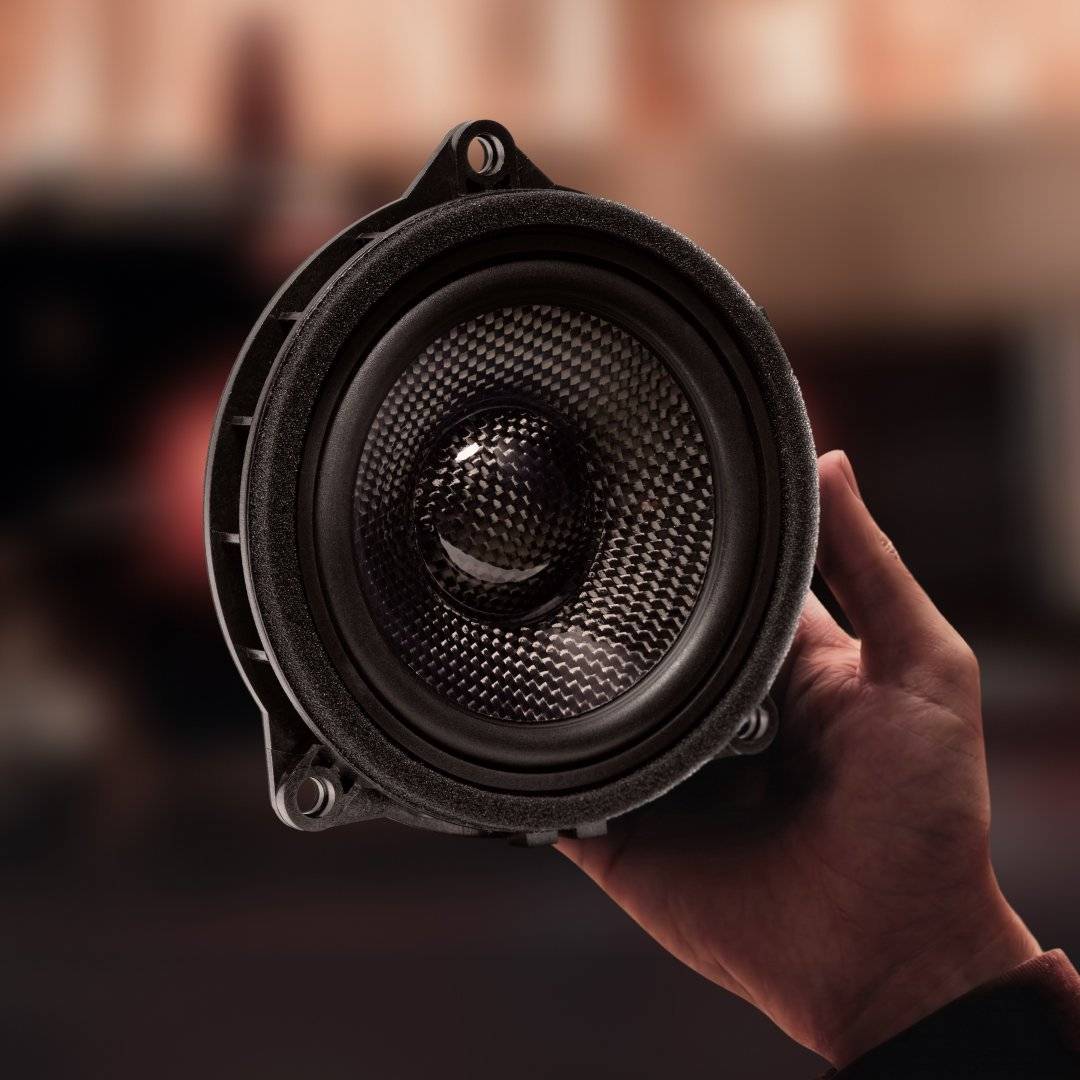
JAKUB: A vented voice coil means you can simply put more power into the driver, because the ventilation allows the movement of the diaphragm to force air to flow through. The air then flows past the magnet, carries away that heated air, and brings in fresh air. So every time the diaphragm moves, that airflow cools the magnet.
 That's the first advantage.
The second advantage is that you avoid compression. The diaphragm's natural movement creates a certain amount of compression between the driver's suspension and the magnet, because there's typically a volume of air trapped there that needs to be vented through the driver's lower suspension as the diaphragm moves. That suspension is made from a mesh material, which lets air pass through, but still has a certain amount of flow resistance.
When you add proper coil ventilation, that flow resistance becomes practically negligible, and the diaphragm doesn't pick up any additional damping in its movement. The same driver with its ventilation port blocked shows a higher resonant frequency, which demonstrates that the airflow is less effective in that case.
Talking about Faraday’s ring around the magnet, it stabilizes the magnetic field inside the magnetic gap. More stable magnetic fields introduce lower nonlinearities in the speaker signal which corresponds directly to lower THD.
What makes the S90 punch that far above a typical woofer?
- RADEK: You said the Signature Edition S90 Woofers pound so hard you won't even let people pair them with the SUB10. What's going on inside the S90 that makes it punch that far above a typical woofer?
MAC: Well, it’s not that it’s technically impossible to pair the S90 woofers with the SUB10…
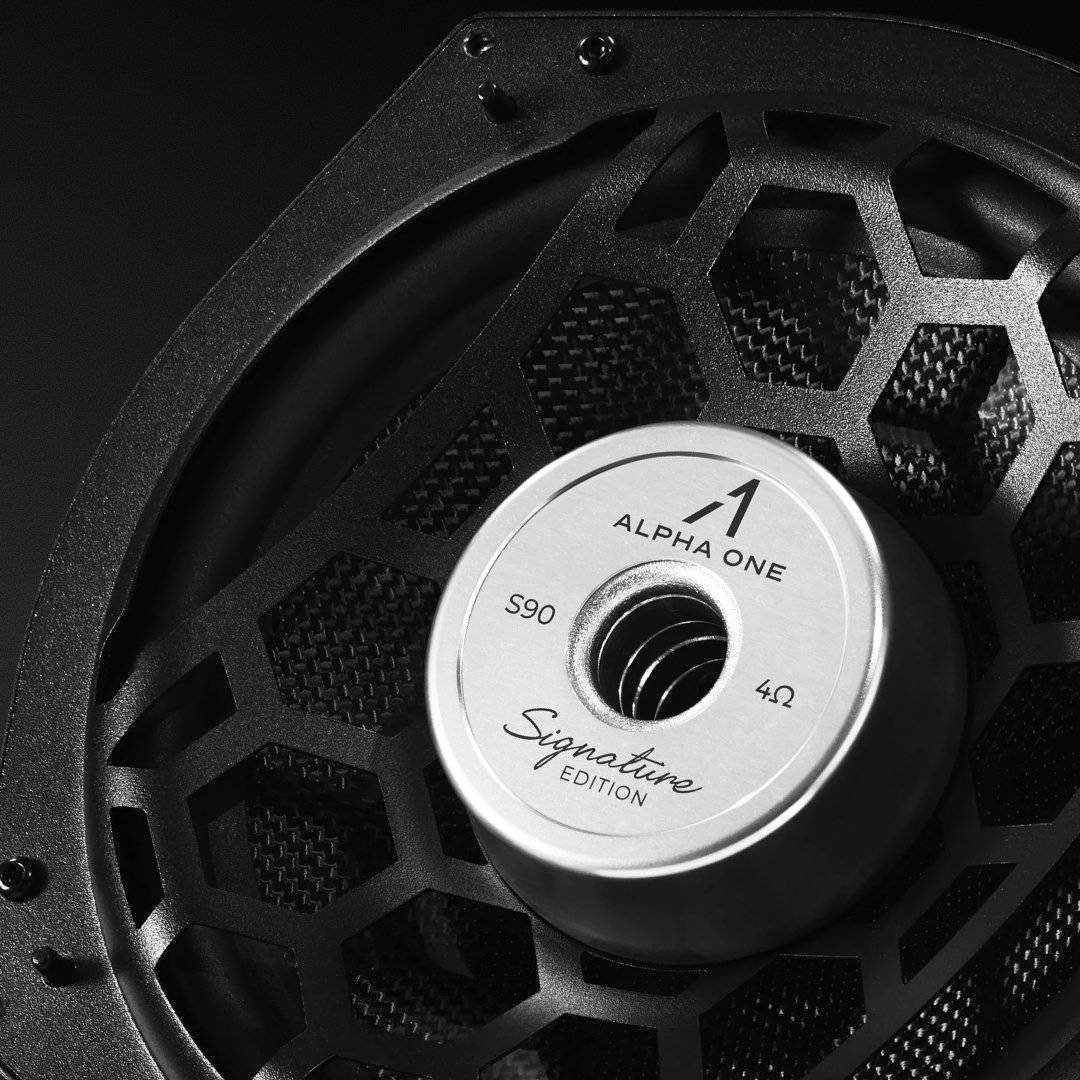 JAKUB: It’s just that the bass increase wouldn’t be as spectacular of a jump as adding either the two S90s or the subwoofer alone. In a certain frequency range, the Signature Edition Woofers offer dynamics akin to those of a sub; however, they are still not able to reach the lowest frequencies due to their size and weight.
MAC: This also depends on the particular chassis and the amp used. The S90s play mind bogglingly when paired with the Lightwave thanks to its much higher power ceiling (compared to UP8, for example). When trying out the setup in our test car—a BMW 5 Series Touring with the Lightwave amp and S90 woofers installed—the reinforcement provided by the SUB10 was too subtle.
JAKUB: Yup, but this is what a stronger SUB12 Signature subwoofer will handle, giving you yet another “wow” factor after the S90s.
- RADEK: Do you have an ETA on the SUB12?
MAC: It’s coming this fall.
Why would you upgrade Alpha One Originals to the Signature Edition?
- RADEK: For a BMW owner who already has the Original installed and is happy, what would be the honest pitch for upgrading? What will they hear in the first 30 seconds?
MAC: The real honest pitch for upgrading from Originals? Getting the person we want to convince seated inside the car with a complete set of Signature Edition Speakers installed for just 5 minutes of music listening. In my opinion, that’s more than enough.
What is the best demo track to listen to on Signature Edition Speakers?
- RADEK: What's a track you'd hand someone the moment they got into a Signature-equipped car for the first time, to prove the point in 90 seconds?
MAC: There are two possible answers to this question…
JAKUB: “Temptation” by Diana Krall. This track has got everything – it’s pleasant, dynamic, it’s got vocals, various atmospheres, and its soundstage is well built.
MAC: Well, that’s one of the two answers: a track that can expose the shortcomings of a lesser soundsystem or highlight the minute details, flavors of a great one. The other answer is slightly simpler – play the track you used to listen to all the time.
Your favorite or one that has a great sentimental value to you. Maybe it’s something that lifted your spirits through high school? Or maybe a song of a band whose concert you went to with your friends, after months of saving up for the tickets?
Whatever the case: you should get ready to experience that track anew.
Alpha One Signature Edition Speakers – Why It’s Worth It?
That’s almost it for today. Instead of doing a traditional summary, to conclude this interview I’ve decided to ask Mac and Jakub one final question…
- RADEK: What's the single thing you're proudest of in the Signature Edition?
JAKUB: The Midrange Speakers – this is the single element I’m proudest of. In my opinion, this is one of the best midranges I’ve heard in my life, period. In the future, it will be incredibly difficult for us to top this design. And when it comes to the entire Signature Edition range in general, I’m really proud of the authenticity of sound, how tangible it is.
MAC: Agreed 100%, I’ve got nothing to add.
RADEK: Cool, thanks for sharing that with our readers!
***
Wondering if the Alpha One Signature Speakers are for you? Still considering if the investment is worth it? Give us a call – let’s discuss what makes these BMW speakers so unique and if they are the right fit for you and your car.
Comments(0)
All ratings
Popular posts:



and get to know all compatible products for your BMW or MINI
Where to find your VIN?