



Radoslaw Zbroinski
May-26-2026
What Is a Passive Crossover? BMW Sound System Upgrade Guide Part 2
If you've spent any time poking around the world of car audio – or read Part 1 of this series on coaxial speakers – you've probably bumped into the term "crossover" more than once. In the simplest possible terms, a passive crossover is a small electrical circuit that splits a full-range audio signal into separate frequency bands. It then sends each one to the speaker that's actually built to reproduce it. Highs go to the tweeter, mids go to the midrange, lows go to the woofer. Without one, you'd be sending the entire signal to every speaker – and that's a recipe for massive distortion, blown tweeters, and a generally muddy mess (low sound quality).
In this article, we're going to look at:
- What a passive crossover actually is (and what's inside it)?
- How passive crossovers differ from active crossovers?
- Where passive crossovers fit in your car audio system?
- Why all of this matters for your BMW sound system upgrade?
So, grab a coffee and let's get into it.
What is a Passive Crossover?
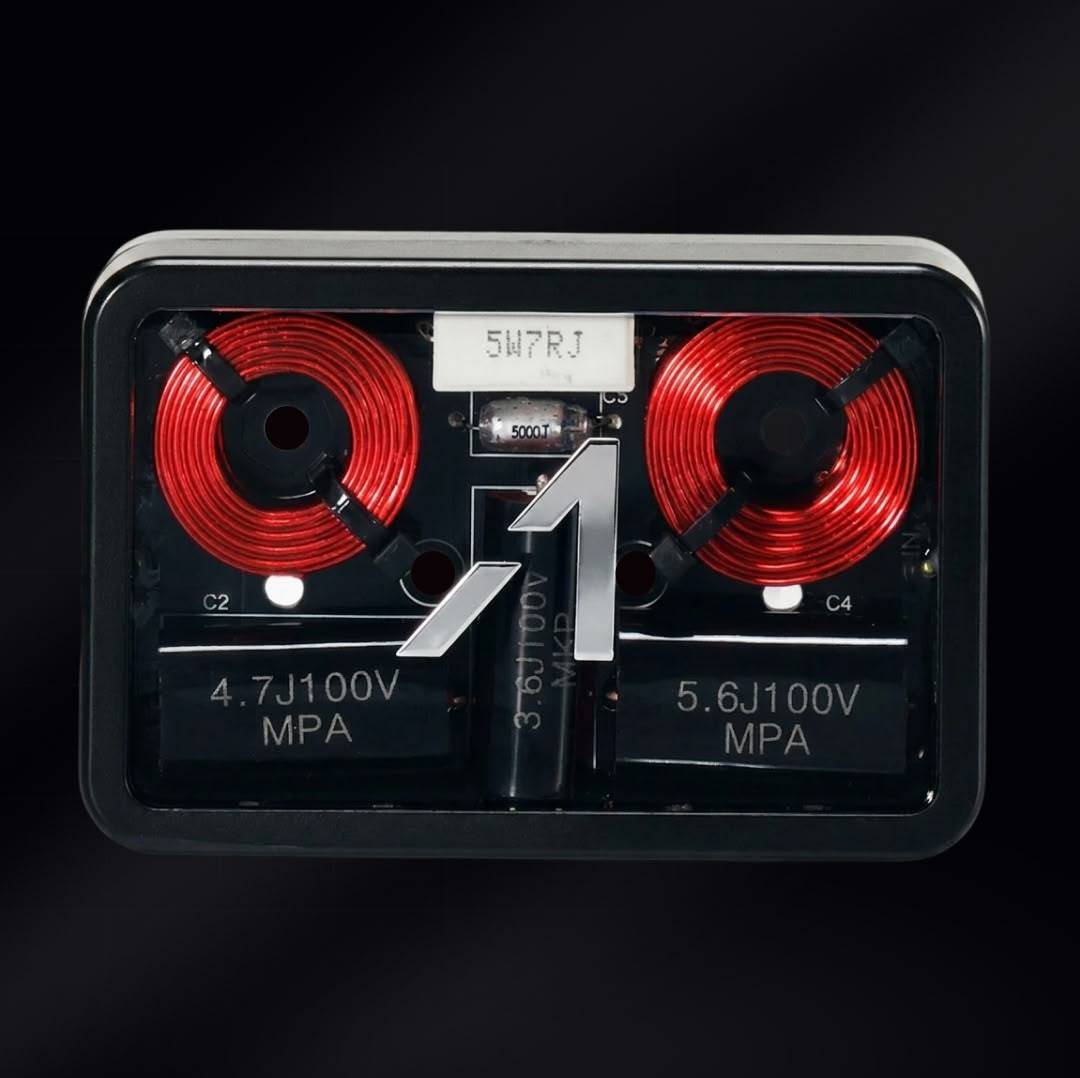 Starting with the boring definition: a passive crossover is a circuit, usually a small board tucked inside a speaker enclosure or housed in its own little box, that filters an incoming audio signal into different frequency ranges. It's called "passive" because it uses passive components – from the moment they are decided and soldered its characteristics are fixed.
Inside a passive crossover, you'll typically find three types of components:
- Capacitors – they block low frequencies and let high frequencies pass through, protecting tweeters from bass they can't handle.
- Inductors – these let low frequencies pass and block high ones.
- Resistors – used to attenuate (lower) the output going to specific drivers or to correct impedance. E.g., a tweeter is too loud relative to the midrange.
Combine these components in the right way and you get a filter circuit – low-pass (lets lows through), high-pass (lets highs through), or band-pass (lets a specific frequency band through). That's it boiled down to the simplest of terms, but in reality all these components also influence impedance curves to allow a seamless phase transition from one speaker to another.
Where does the passive crossover sit in the signal chain?
This is the part that trips people up, so it's worth nailing down.
A passive crossover sits after the amplifier and before the speakers. The amp takes a line level signal, boosts it to a higher voltage, and then that amplified signal hits the crossover, which splits it up and routes each frequency band to the right driver. The placement is actually one of the major differences between passive and active crossovers, but we'll come back to it a bit later.
How does a passive crossover actually work?
Usually, the audio signal comes in as one big mixed stream – bass, mids, highs, all together. One path is wide open for low frequencies but blocked off at the top (low-pass), the other path is wide open for high frequencies but blocked at the bottom (high-pass). In a 3-way passive crossover, there's a third path in the middle for the midrange speakers.
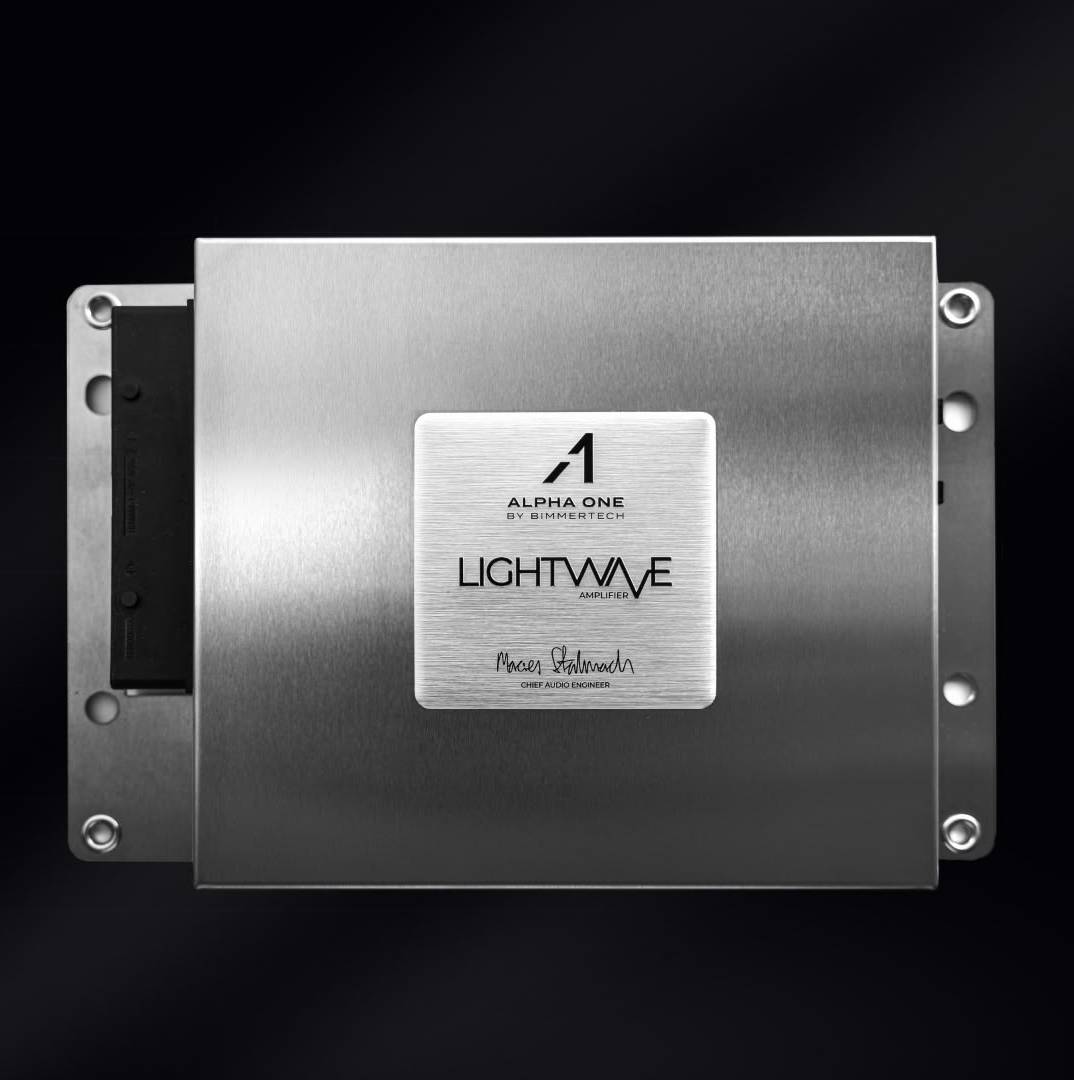
However, this works differently in the case of Alpha One Amplifiers. The audio signal from them is already cut for the midranges and tweeters. Our Passive Crossover takes this signal to divide and set the band between the mids and tweeters.
The point at which the crossover splits the signal is called the crossover point (or crossover frequency). For example, a typical 2-way crossover might be set at around 2-5 kHz – meaning everything below that goes to the woofer and everything above goes to the tweeter. The crossover doesn't cut the signal off like a guillotine, though. It rolls off gradually, at a rate measured in decibels per octave (the "slope").
The slope steepness and type affect both this separation as well as the phase in different ways. Steeper slopes usually give cleaner separation, while gentler slopes give a more natural blend between drivers. When it comes to slope types, each order flips the phase by an additional 90 degrees – first-order slope does it by 90°, second-order slope by 180°, and so on. From our experience, the best blend is achieved with either second-order or fourth-order slopes.
The key thing to understand is that passive crossovers are custom-designed for specific driver impedance and frequency curves, requiring rebuilding for modifications or upgrades. In short, they are tuned for a specific frequency, with specific speakers, at a specific impedance. The capacitor and inductor values are calculated based on all of that. Swap in a different speaker with a different impedance and the crossover frequency shifts. This is why you can't just yank a passive crossover out of one speaker system and bolt it into another and expect it to work properly.
Passive vs. Active Crossovers – What's the Difference?
 Right, so we've established what a passive crossover does. But you've probably also heard about active crossovers and the natural question is: which one is better? The honest answer is "it depends," because as is often the case with car audio, different things serve different purposes.
Active crossovers sit before the amplifier, not after it like passive ones. They work on the line level (pre-amp) signal, electronically dividing it into bands even before the signal gets amplified. Then each band gets its own amplifier channel. So if you have an active 3-way setup, you need at least three amplifier channels – one for tweeters, one for mids, and one for woofers.
With some added complexity, this brings some advantages though:
- Adjustable crossover frequencies – active crossovers offer more control over frequency adjustment compared to passive crossovers, which generally are impossible to fine-tune after their components have been installed.
- Independent output levels – it’s easier to fine-tune the volume of each driver independently, which makes balancing the whole system simpler; for a passive crossover you would need to solder in a resistor to lower the specific volume.
- Lower distortion at high power – because the active crossover works on the signal before amplification, the amp isn't wasting power amplifying frequencies that are about to get filtered out anyway.
The catch? Active crossovers need their own power supply, more wiring, more amp channels, and they typically cost much more. They're also a bit trickier to install and even more so to tune properly.
Passive crossovers, on the other hand, have their own perks:
- No power supply needed – they work passively to modify the audio signal.
- Simpler installation – fewer wires, fewer connections, fewer things to set.
- Lower cost – passive crossovers are highly cost-effective and easy to install as they require only a single amplifier channel to run a multi-speaker system.
- Often built into the speakers themselves – many component speaker sets come with their own matched passive crossovers.
And that's exactly the case for our Alpha One Signature Edition Speakers; every midrange and tweeter pair (including the coaxial S45C's) gets delivered with a separate, tailor designed second order passive crossover.
Anyway, here's a quick side-by-side:
| Characteristic | Passive crossover | Active crossover |
| Location in the signal chain | After the amplifier | Before the amplifier |
| Power supply | Not needed | Required |
| Adjustability | Fixed (set by component parameters) | Adjustable crossover frequencies and levels |
| Cost | Lower | Higher (often several times more) |
| Installation complexity | Pretty easy – plug-and-play in most cases | More complexity, more wiring |
| Best for | Most factory-replacement upgrades, component speaker sets | High-end custom builds, bi-amped or tri-amped setups |
In a typical BMW sound system upgrade, you're usually working with a mix of both worlds. A modern amp with built-in DSP (like the Alpha One Amplifier) effectively handles active crossover duties at the line level, while the speakers themselves may still have small passive networks at the driver level to fine-tune the handoff between tweeter and midrange.
That being said, each of these is merely a half-measure that does its job good enough.
Why Does Any of This Matter for Your BMW?
Fair question. Let's bring it back to the car.
If you're driving a BMW with the Base or HiFi system, your factory speakers are doing the best they can with what they've been given – which is to say, not much. The factory amp is underpowered and the speakers are made down to a price. The result is a system that gets loud-ish, but distorts when you push it and never really delivers the clarity you'd expect from a car with a propeller badge on the hood. So don't expect great sound with that.
When you start thinking about a speaker upgrade or a full audio upgrade, crossovers stop being an abstract concept and start being a practical concern. Here's why:
- Your tweeter needs protection – a properly designed crossover keeps tweeters from being fried by too much low-frequency signal.
- Your woofer shouldn't be reproducing high frequencies – filtering off the highs lets the woofer focus on what it's effective at, i.e., mid-bass and low frequencies.
- Your soundstage depends on it – when each driver only plays just the frequency band it's designed for, and in phase synergy between the drivers, the whole system snaps into focus.
It's also worth noting that the difference between a well-designed crossover and a cheap one is genuinely audible. Not only that, you could have two electrically IDENTICAL crossovers that have been put together differently and it would be enough to make an astonishing difference.
We're talking about how cleanly the frequencies split, how well the drivers blend in the crossover region, and how the system behaves at high volume. Cheap crossovers with low-quality capacitors and undersized inductors can introduce their own distortion, especially when you push them.
To Sum It All Up...
A passive crossover is a circuit built from capacitors, inductors, and resistors that sits between your amplifier and your speakers. It splits the audio signal into different frequency ranges and routes each one to the speaker designed to handle it. It needs no power, it's simple to install, and when it's well-designed, it's pretty much invisible – which is exactly what you want from any piece of audio gear. You don't notice it. You notice that everything just sounds right.
Active crossovers offer more control and lower distortion at high power, at the cost of extra complexity and price. In a modern BMW upgrade, you usually get a hybrid setup – active crossover work done in the DSP of a quality amplifier, with passive networks handling the final handoff at the speaker level.
If you're thinking about upgrading your car audio system, you don't need to become an expert in crossover design. But understanding what's happening under the hood (or, more accurately, behind the door panels) helps you make smarter decisions about where to spend your money and what to expect from the upgrade.
FAQ
Comments(0)
All ratings
Popular posts:


and get to know all compatible products for your BMW or MINI
Where to find your VIN?